
Insaniyyat
Insaniyyat is a society of Palestinian anthropologists devoted to promoting anthropological inquiry among Palestinians and about Palestine and the rest of the world. It advocates the development of anthropological knowledge in diverse subfields and related ethnographic research, while always attuned to social and political justice. It aims to promote anthropological scholarship to various audiences in Palestine and beyond.
Browse recent publications from members of the Insaniyyat community. If you would like your work featured, please contact insaniyyat.anthropology@gmail.com with a recently published artistic, academic, or community-based work related to Palestine and anthropology.
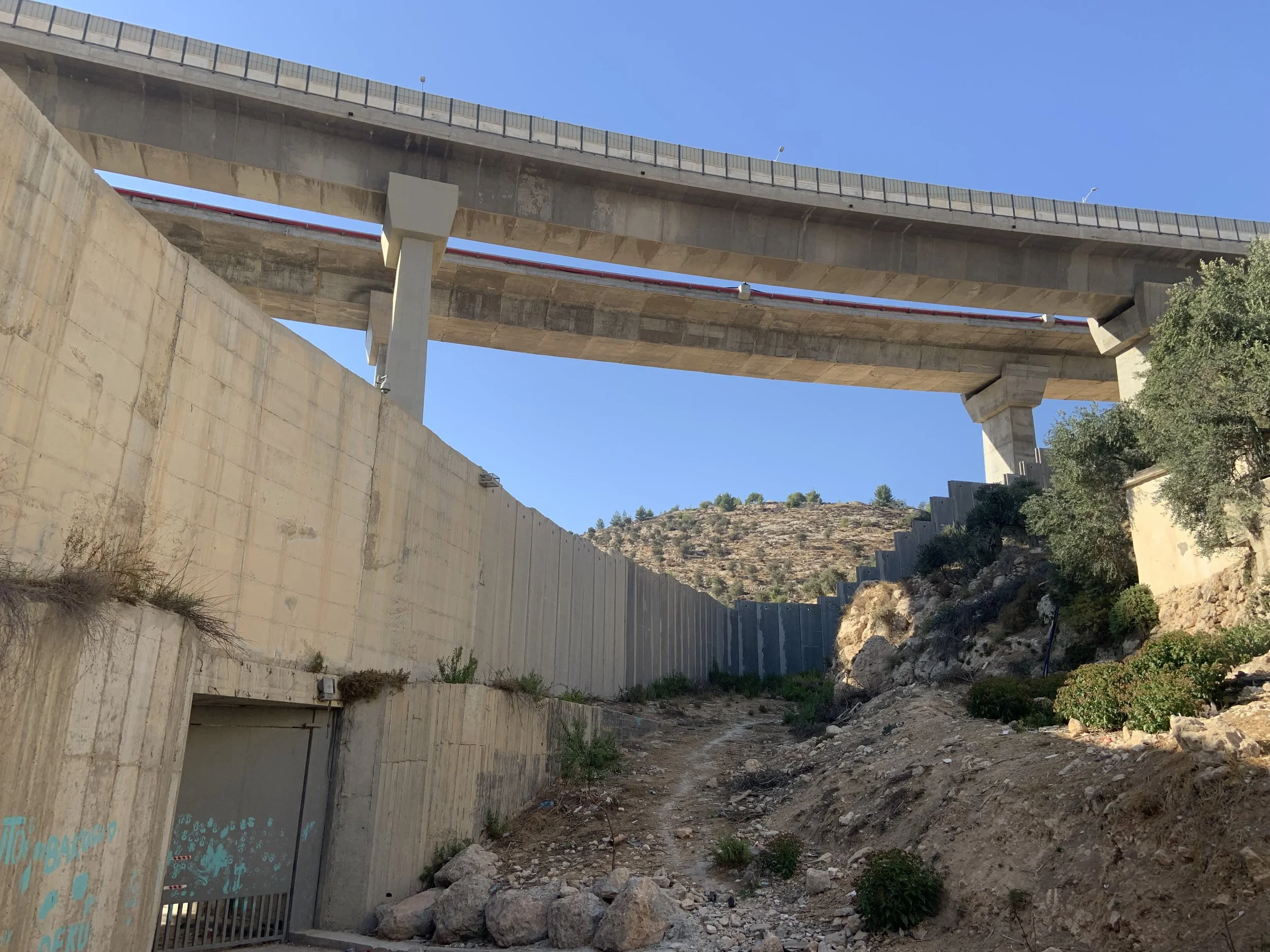
A photo of the wall cutting through Bir Ona, highway, and the olive orchards behind it. Photo courtesy of Thayer Hastings
Featured Works
Immobility and Care on the Fringes of Personhood in Jerusalem
Thayer Hastings
Although Sara was born in and had never left the area of the West Bank and was in her late 20s when we met, she still had not obtained basic documentation, registration of an identification number, and ultimately recognition of personhood. The state claims that the family had missed a deadline for registering her birth in a Bethlehem hospital and this had cascaded into a lifelong impediment for Sara. Without an identity card, many basic aspects of life founded on bureaucratic documentation became difficult if not unattainable: travel, licensing, driving, higher education, and so on. Although she had challenged her non-status through the Israeli court systems for a decade, she still had not made any substantive progress in obtaining these foundational records. As a result, she lived a geographically contained life resembling a situation of civil death, one that was automatically applied to her and others like her since she was born rather than one that was issued punitively.
Land, terrain, territory
Stuart Elden
This paper outlines a way toward conceptual and historical clarity around the question of territory. The aim is not to define territory, in the sense of a single meaning; but rather to indicate the issues at stake in grasping how it has been understood in different historical and geographical contexts. It does so first by critically interrogating work on territoriality, suggesting that neither the biological nor the social uses of this term are particularly profitable ways to approach the historically more specific category of ‘territory’. Instead, ideas of ‘land’ and ‘terrain’ are examined, suggesting that these political-economic and political-strategic relations are essential to understanding ‘territory’, yet ultimately insufficient. Territory needs to be understood in terms of its relation to space, itself a calculative category that is dependent on the existence of a range of techniques. Ultimately this requires rethinking unproblematic definitions of territory as a ‘bounded space’ or the state as a ‘bordered power container’, because both presuppose the two things that should be most interrogated, space and boundaries. Rather than boundaries being the distinction between place and space, or land or terrain and territory, boundaries are a second-order problem founded upon a particular sense of calculation and concomitant grasp of space. Territory then can be understood as a political technology: it comprises techniques for measuring land and controlling terrain, and measure and control — the technical and the legal — must be thought alongside the economic and strategic.
Updates
July 2024
June 2024
April 2024
March 2024
Insaniyyat Talks: Censored: Palestine in European Academia
Since the beginning of Israel’s war on Gaza, many universities and higher education institutions across Europe have intensified efforts to repress Palestinian and pro-Palestinian voices, and censor critical debate on Palestine. This has included; the cancelation of events and lectures, the terminating of critical visiting scholars, threats to de-matriculate pro-Palestinian students, and the censorship of critical frameworks to understand the conflict such as Apartheid and settler colonialism.
Call for Papers: Holding onto Palestine. Reimagining Anthropology at a Time of Genocide, 2024 - Deadline Extended
Much like 1948 and 1967, 7 October 2023 ushered in a violent project of erasure and elimination of Palestinians as an indigenous population. While uncertainty, fear and anguish have been features of Palestinian daily life for decades, at this time of high-flame violence, with their habitat becoming spaces of blatantly visible non-life, questions of the meaning and practice of remaining present, of existence itself, have never been more urgent. These extreme times require a bold agenda for critical inquiry. How can anthropology make sense of contemporary mass killing, large scale physical destruction, genocidal rhetoric and transfer plans as colonial powers seek to destroy and empty Gaza while silencing criticism and dissent dissent around the world?
Voices from Gaza: Messages from Devastation
October 2023
Insaniyyat Talks: Indigeneity, Land and Colonial Settlement in Brazil and in Palestine: Intersections and Struggles
Given the urgency of tackling colonial violence in Gaza, this event is a partnership between ABA (Brazilian Association of Anthropology) and Insaniyyat (Society of Palestinian Anthropologists), around key topics both in Brazilian and Palestinian contexts. How can well-established anthropological work on indigeneity, land and colonial settlement in Palestinian contexts resonate with comparable work in/about Brazil? And what does anthropology in Brazilian contexts have to offer back to the Palestinian context?
Holding onto Palestine. Reimagining Anthropology at a Time of Genocide, 12 - 15 September 2024 (Online)
Keynote Lecture: “Unethical Anthropology and Anthropology of the Unethical” By Prof. Ghassan Hage
Much like 1948 and 1967, 7 October 2023 ushered in a violent project of erasure and elimination of Palestinians as an indigenous population. While uncertainty, fear and anguish have been features of Palestinian daily life for decades, at this time of high-flame violence, with their habitat becoming spaces of blatantly visible non-life, questions of the meaning and practice of remaining present, of existence itself, have never been more urgent.
Insaniyyat Talks: Conceiving Return Against a time of Genocide
The 2023-2024 genocide in Palestine is a product of Israel’s intensely racialized and militarized settler-colonial rule. In Gaza, Israel has killed many more than 35,000 people and destroyed the medical, higher education, and agricultural sectors. The housing sector and spaces of cultural and religious life and of primary education have been decimated. Both a medium-term possibility of rebuilding life in Gaza and ways to build toward Palestinian longstanding visions of return and liberation face dire threats. In this forum, we focus on the theme of return, especially in thinking and action from Gaza, ranging from memories of 1948, to the Great March of Return of 2018, to how Palestinians imagine the transformative return of liberation today across many Palestinian places.
Since the beginning of this current, most vicious, Israeli war on the people of Gaza, family and friends, including members of our Insaniyyat community, have been anxiously trying to check on loved ones across Gaza. We humbly offer these voices from Gaza under siege that attest to Gazans’ immense suffering but also to their unbounded courage and will to survive.